Instantaneous Pressure Relief: Sourcing Rupture Discs for Toxic Chemical Isolation
Introduction
In high-pressure chemical reactors and storage systems, overpressure events can happen in milliseconds due to runaway exothermic reactions or sudden fluid blockages. While spring-loaded Safety Relief Valves (SRVs) are widely used, their moving internal parts can jam or become gummed up if exposed to highly corrosive, sticky, or polymerizing process media.
To guarantee instant, foolproof pressure relief without risk of mechanical failure, plants deploy Rupture Discs (Bursting Discs). These non-reclosing, differential pressure relief devices are designed to fail open at a precisely calibrated burst pressure, venting dangerous overpressure safely.
Forward-Acting vs. Reverse-Acting Geometry
Rupture discs are divided into two primary mechanical styles based on how the process pressure acts upon the pre-bulked dome:
Forward-Acting Discs: The process pressure acts on the concave side of the dome, placing the metal under tensile stress. As pressure reaches the limit, the metal stretches until it tears open from the center. These are sensitive to process cycles and are prone to fatigue over time.
Reverse-Acting Discs: The pressure acts on the convex side, placing the dome under compressive loading. When the burst rating is reached, the dome instantly collapses (reverses), driving the metal against internal scoring lines or knife blades to create a full, non-fragmenting opening. Reverse-acting designs can operate at up to 90-95% of their rated burst pressure without suffering fatigue failure.
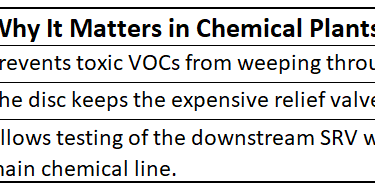
The Combination Strategy: Isone and Protect
In highly toxic chemical facilities, engineers rarely use a rupture disc entirely alone. Instead, they install a rupture disc upstream of a safety relief valve.