Engineering TEMA Shell and Tube Heat Exchangers: Managing Thermal Stress in Refining Loops
Introduction
Petrochemical refining requires moving massive amounts of thermal energy. Crude oil must be preheated before entering the atmospheric distillation column, while finished gasoline and diesel must be cooled before storage. Shell and Tube Heat Exchangers are the primary equipment utilized for these massive thermal transfers.
However, because one fluid flows inside the tubes while another fluid flows around them inside the outer shell, these units experience extreme temperature differentials. If these differentials are not managed correctly during design, thermal expansion will warp the tubes, crack the tubesheet welds, and cause dangerous internal fluid mixing. Here is how the Tubular Exchanger Manufacturers Association (TEMA) standards solve this issue.
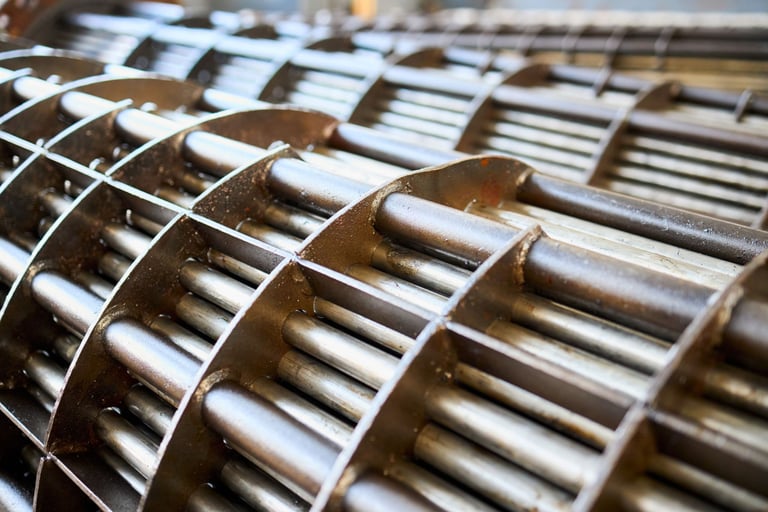
Precision Manufactured Shell & Tube Heat Exchanger Tube Bundle
TEMA Classifications: Match the Duty to the Letter
TEMA categorizes heat exchangers into three distinct mechanical classes based on the severity of the service:
TEMA Class R: For severe petroleum refining duties. This class mandates thick walls, heavy-duty flanges, and premium alloys to withstand corrosive hydrocarbon environments and continuous high-temperature cycles.
TEMA Class C: Designed for general commercial and moderate process utility services. Focuses on cost-efficiency and space saving.
TEMA Class B: Tailored for chemical process industry operations where chemical corrosion, rather than high pressure, is the primary threat.
The Mechanics of Thermal Expansion Relief
When cold cooling water passes through the tubes and hot oil (350℃) enters the shell, the shell steel and the tube steel expand at completely different rates. Engineers utilize three main configurations to relieve this physical stress:
[ Heat Exchanger Expansion Solutions ] [Fixed Tubesheet with Expansion Joint] ➔ Flexible bellows on shell body absorb minor movement. [U-Tube Design] ➔ Tubes bend freely inside the shell; zero axial stress. [Floating Head (TEMA Type S/T)] ➔ One end of the tubesheet floats freely inside the shell cap.
U-Tube Exchangers (TEMA Type _U): The tube bundle is bent into a 'U' shape and fixed at only one end. The bent end can expand and contract completely freely inside the shell. This is highly reliable but makes mechanical cleaning inside the bent tubes difficult.
Floating Head Exchangers (TEMA Type S or T): One tubesheet is bolted to the shell, while the second tubesheet at the opposite end "floats" freely inside the shell cover. This allows full thermal expansion while keeping both fluid loops completely independent and easily accessible for high-pressure hydro-blasting during maintenance turnarounds.
Thermal Efficiency Engineered for Severe Service Pipemav supplies ASME-compliant, TEMA Class R and B shell and tube heat exchangers featuring advanced metallurgy (including copper-nickel, titanium, and duplex stainless steel).