Optimizing Mass Transfer: Choosing Structured Packing vs. Trays for Refinery Distillation Columns
Today, we are taking a deep dive into the internal components, safety mechanisms, and structural networks that allow these plants to run cleanly, efficiently, and without catastrophic failures.
We cover Distillation Column Internals (Structured Packing vs. Fractionation Trays), Emergency Pressure-Relief & Flare Systems, and High-Pressure Piping Systems (Sch 160 & XXS). These elements represent the processing heart, the ultimate safety barrier, and the high-pressure veins of any heavy industrial facility.
Introduction
In oil refining and petrochemical manufacturing, the distillation column is the central profit engine. Whether you are splitting crude oil into fuel fractions or separating high-purity ethylene from propylene, the efficiency of your column determines your entire plant's yield.
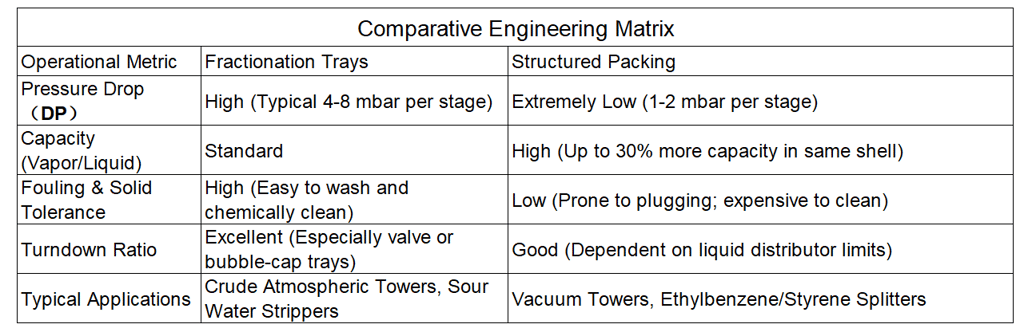
When rebuilding or retrofitting a damaged distillation tower, engineers face a critical structural decision: Should the column use fractionation trays, or should it be packed with structured or random packing? Making the wrong choice can lead to premature column flooding, high pressure drops, or failing to meet product purity specifications. Here is how to evaluate the two primary mass-transfer technologies for your next turnaround or rebuild.
[ Vapor Flow ↑ ] ========================= <-- Tray Floor | | (Bubble Caps / Valves promote vapor-liquid contact) ========================= <-- Tray Floor [ Liquid Flow ↓ ]
1. Fractionation Trays: The Traditional Workhorses
Trays divide a vertical column into distinct, staged levels. Liquid flows across each tray deck and down through "downcomers" to the stage below, while vapor bubbles up through openings (sieves, valves, or bubble caps) in the tray floor, creating a highly turbulent contact zone.
Best For: High liquid-to-gas loading, highly fouling or corrosive fluids, and systems operating under high pressure.
The Advantage: Trays are highly robust and incredibly tolerant of solids, polymers, and particulates. If your crude feedstock is heavy, dirty, or highly corrosive, trays are far easier to clean and mechanically service.
The Downside: Trays create a much higher pressure drop ($DP$) per theoretical stage compared to packing, and they require a larger tower diameter to prevent "entrainment" (liquid being carried upward by gas).
2. Structured Packing: The Low-Pressure-Drop Champion
Structured packing consists of corrugated metal sheets arranged in a uniform, geometric block pattern. This design forces liquid to spread in a thin, even film over a massive surface area while allowing gas to rise through open, low-resistance channels.
Best For: Vacuum distillation units (VDUs), temperature-sensitive chemical separations, and debottlenecking projects where you need to squeeze more capacity out of an existing shell.
The Advantage: Structured packing offers the lowest pressure drop per theoretical stage. Lower pressure drops lower the boiling point inside the column, reducing energy consumption and preventing thermal degradation of sensitive chemicals.
The Downside: Highly sensitive to liquid maldistribution. If the liquid entering the top of the bed is not distributed perfectly evenly, it will channel down the walls, completely destroying separation efficiency. It is also highly susceptible to plugging if solids are present in the process stream.
Revitalize Your Separation Columns with Pipemav Whether you need high-capacity sieve trays, heavy-duty bubble cap setups, or high-efficiency structured packing beds, Pipemav supplies custom-engineered tower internals designed to maximize throughput.