Specifying Shell and Tube Heat Exchangers for High-Fouling Crude Processes
Introduction
In the rebuilding phase of an oil refinery or petrochemical complex, restoring thermal efficiency is paramount. Distillation columns and hydrotreating units cannot function without a massive matrix of heat exchangers to preheat crude oil and cool down volatile fractions.
When infrastructure has been offline, dormant, or partially damaged, returning systems face severe fouling and thermal shock. For these punishing, high-capacity duties, the traditional Shell and Tube Heat Exchanger remains the industry backbone—provided it is engineered to the correct international standards.
The TEMA Standard: Sourcing the Correct Configuration
The Tubular Exchanger Manufacturers Association (TEMA) defines the strict mechanical parameters for shell and tube units. In refinery reconstruction, three specific TEMA types are favored for their durability and ease of maintenance:
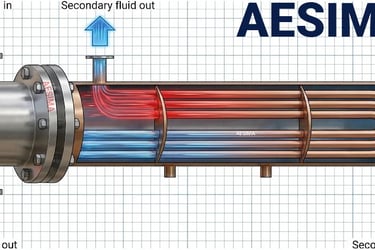
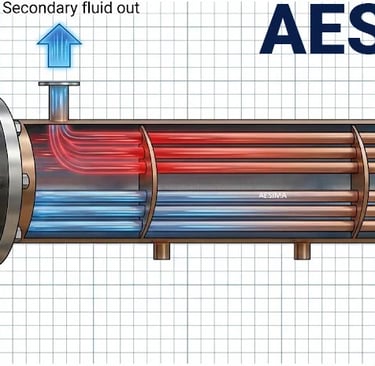
TEMA High-Maintenance Selections: - AES (Split Ring Floating Head) ➔ Easy bundle removal for high-fouling crude lines. - BFU (U-Tube Bundle) ➔ Allows unrestricted thermal expansion, preventing tubesheet warping.
TEMA Type AES (Channel and Removable Cover, Split Ring Floating Head): This is the gold standard for crude oil preheat trains. The floating head design allows the entire tube bundle to expand and contract freely under extreme temperatures (>350℃), completely eliminating thermal stress on the tubesheet. Crucially, the bundle can be pulled out entirely for rapid mechanical hydro-blasting during routine shutdowns.
TEMA Type BFU (Bonnet, Two-Pass Shell, U-Tube): Highly cost-effective for clean fluids, high-pressure steam, or gas applications. Because the tubes are bent in a U-shape, they handle high thermal differentials perfectly, though they are harder to clean internally if the fluid carries heavy particulates.
Metallurgy for Severe Hydrocarbon Services
When rebuilding columns, matching the exchanger metallurgy to the specific crude oil profile prevents secondary corrosion disasters:
High-Sulfur / Sour Crude: Standard carbon steel will suffer from rapid sulfidic corrosion. Upgrading tubes to Chromium-Molybdenum alloys (e.g., 5Cr-1/2Mo) or stabilized stainless steel (SS 321 or SS 347) is required to prevent hydrogen attack.
Cooling Water Seawater Intakes: If the refinery relies on seawater for cooling, copper-nickel or Titanium tubes are mandatory to resist localized pitting and marine bio-fouling.
Engineered for High Thermal Performance
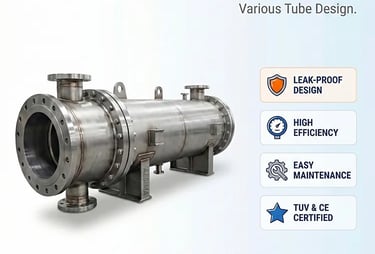
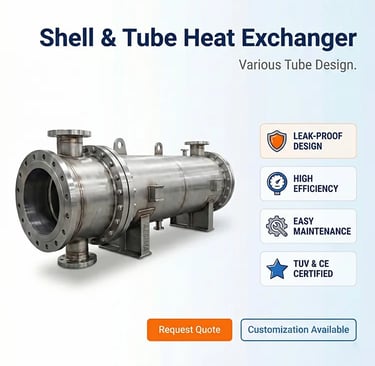
Pipemav supplies fully certified, ASME Section VIII and TEMA-compliant shell and tube heat exchangers designed to withstand the harsh thermal cycles of modern petrochemical refining.