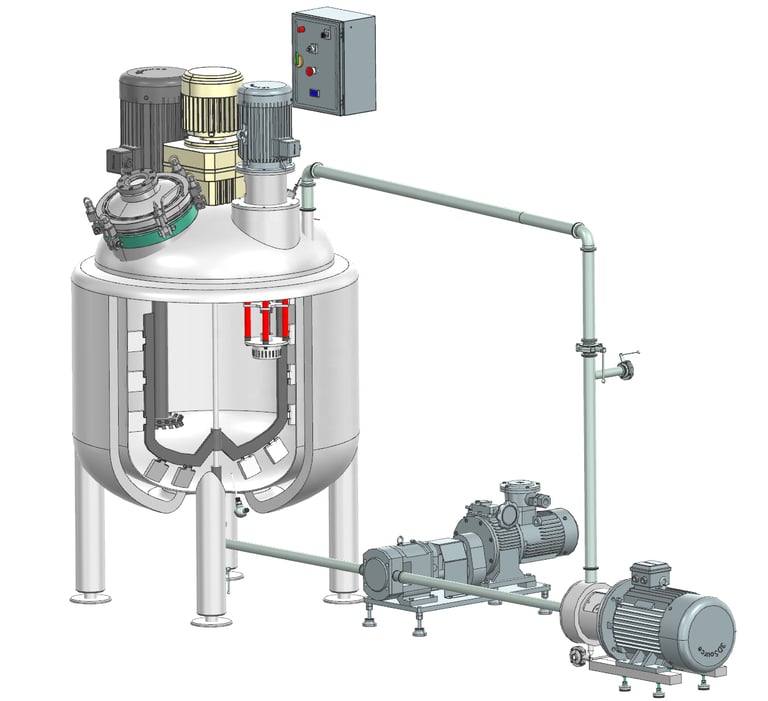
Continuing our high-impact strategic focus on global petrochemical reconstruction, energy security, and capacity rebuilding, today’s batch moves into the critical machinery and storage assets that form the structural core of any processing plant: Gas Compressors, High-Pressure Storage Tanks/Pressure Vessels, and Inline Industrial Flowmeters.
When rebuilding oil and gas networks, gas compression is essential to maintain transport pressure, pressure vessels form the literal reactors and separation towers, and precision flowmeters act as the cash registers and safety monitors of the facility. Sourcing these complex assets requires extreme engineering precision.
Sourcing ASME Section VIII Pressure Vessels for Petrochemical Refineries and Fractionation Columns
Introduction
You cannot process petrochemicals without containing them under high pressures and temperatures. Distillation towers, flash drums, hydrotreaters, and liquified gas storage spheres form the literal landscape of a refinery. When these massive pressure vessels are damaged or destroyed, the entire production capacity of a nation can grind to a halt.
As EPC contractors step in to rebuild these processing units, strict compliance with the ASME Section VIII Code (Division 1 & 2) is mandatory. Sourcing these long-lead, heavy-wall items requires deep technical execution to ensure the vessels can withstand decades of punishing cyclic thermal loading.
Division 1 vs. Division 2: Optimizing Material and Cost
When ordering replacement pressure vessels for a chemical plant rebuild, understanding the distinction between ASME Section VIII Division 1 and Division 2 can save millions of dollars and weeks of fabrication time:
ASME Section VIII Division 1 (Design by Formula): Relies on conservative formulas and higher safety factors (typically 3.5 to 1). This results in thicker vessel walls. It is faster to design and ideal for standard, low-to-medium pressure utility drums and storage tanks.
ASME Section VIII Division 2 (Design by Analysis): Utilizes advanced finite element analysis (FEA) and a lower safety factor (3.0 to 1). This allows for significantly thinner vessel walls while maintaining identical safety levels. For massive distillation columns or ultra-high-pressure reactors, Division 2 drastically cuts raw steel weight and welding hours, accelerating lead times.
Critical Manufacturing Benchmarks for Severe Petrochemical Service
High-Stress Vessel Processing Checklist: Heavy Plate Rolling ➔ Full Penetration Welding ➔ 100% Radiographic Testing (RT) ➔ Post-Weld Heat Treatment (PWHT)
Corrosion Allowance Sizing: Because newly restarted plants often handle unpredictable, unrefined crude compositions initially, engineers should specify a generous corrosion allowance (typically 3mm to 6mm) added to the calculated structural wall thickness.
Post-Weld Heat Treatment (PWHT): The intense heat used to weld heavy steel plates leaves massive residual stresses locked inside the metal joints. PWHT involves heating the completed vessel inside a giant furnace to approximately 600℃ and cooling it slowly. This stress-relief process is mandatory for vessels handling amine solutions, caustic media, or sour gas to prevent environmental cracking.
The Structural Core of Modern Refining Infrastructure
Pipemav partners with world-class fabrication facilities to supply heavy-wall ASME Section VIII Division 1 & 2 pressure vessels, reactors, and storage systems with full material traceability.