Rebuilding the Last Line of Defense: Specifying Knock-Out Drums and Flare Headers for Refinery Safety
Introduction
A chemical refinery is essentially a highly controlled pressure cooker. When utility power fails, a cooling water pump seizes, or an exothermic reaction runs away, pressures can climb exponentially in seconds. The Emergency Flare System is a refinery's ultimate safety net. It collects massive volumes of hazardous, flammable gases from relief valves across the entire complex and combusts them safely.
During facility reconstruction, rebuilding a fully compliant, robust relief header network is non-negotiable. This guide breaks down the critical components—from the relief manifold to the flare tip—required to restore safe, high-volume emergency depressurization.
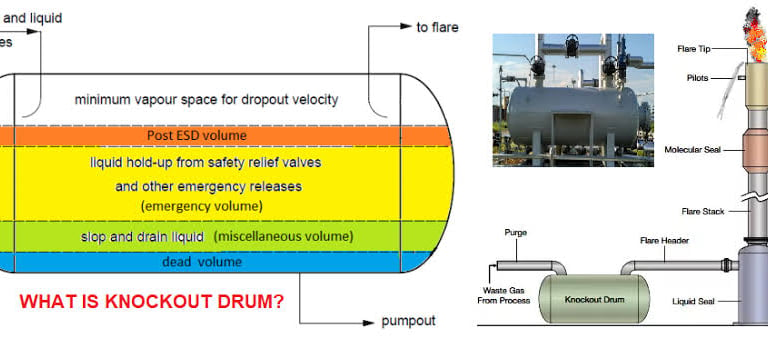
Refinery Flare System & Knockout Drum (KOD) Configuration.
The Safety Sequence
To understand how these safety systems function under emergency conditions, follow the critical path of relieved gas:
1.Relief Valve (PRV) Activation:Instantaneous。
Overpressure in a process vessel triggers the Pressure Relief Valve, discharging high-velocity hazardous gases and entrained liquids into the localized collector headers.
2.Vessel Knock-Out Drum (KOD) Separation:Continuous Flow。
The gas-liquid mixture enters the massive horizontal KOD. As the cross-sectional area expands, vapor velocity drops sharply. Liquids fall to the bottom of the drum, while dry gas is drawn from the top.
3.Liquid Seal Isolation:Static Protection。
The separated dry gas travels through a liquid seal vessel. This water barrier prevents any atmospheric air or oxygen from traveling backward down the header, eliminating the risk of internal pipeline explosions.
4.Controlled Combustion at the Flare Tip:Terminal Phase。
The gas ascends the flare stack and is ignited safely at the flare tip via continuous pilot burners, converting hazardous hydrocarbons into safer combustion byproducts.
Modern Flare Gas Recovery Units (FGRU): Reducing Emissions
In modern reconstruction, flares are no longer just safety vents; they are targets for emissions reduction. Incorporating a Flare Gas Recovery Unit (FGRU) allows plants to capture continuous low-volume waste gases (such as packing leaks or minor valve bypasses).
Instead of routing this gas directly to the flare tip, the FGRU compresses it and redirects it back into the plant's fuel gas header to power boilers and process heaters, turning a potential emission into free operating energy.
Engineered for Maximum Reliability Under Crisis
Pipemav provides certified high-volume Knock-Out Drums, low-temperature header piping, and advanced flare system components built to withstand extreme relief pressures.