Flamepath Deflagration Attenuation: Sourcing Inline Flame Arresters for Volatile Vapor Lines
Introduction
Chemical tank farms, solvent storage facilities, and pharmaceutical vapor recovery systems continuously generate highly flammable atmospheres. If a spark from an static discharge, maintenance welding, or lightning strikes an open vent line, a combustion wave can propagate backward into the piping, triggering a massive, catastrophic storage tank explosion.
To isolate accidental ignition events and extinguish flame fronts before they can cause widespread destruction, safety systems must deploy Inline Deflagration Flame Arresters. These critical bi-directional passive safety devices act as thermal heat sinks, letting process gases pass through freely while quenching flame propagation instantly.
The Thermodynamics of Flame Quenching
The core mechanism of an inline flame arrester relies on a simple physics principle: cooling the burning gas below its Auto-Ignition Temperature (AIT).
Inside the housing sits a tightly packed matrix of corrugated stainless steel ribbons wound together—known as the flame element core. This element splits the incoming single flame front into thousands of microscopic flamelets traveling through tiny triangular channels.
As these flamelets pass through the highly conductive metal walls, the element absorbs the thermal energy exponentially. The heat is dissipated away so quickly that the fire starves, suffocating the combustion wave within millimeters of entry while allowing the unburned vapor pressure to vent safely downstream.
Specifying the Correct Gap: MESG Ratings
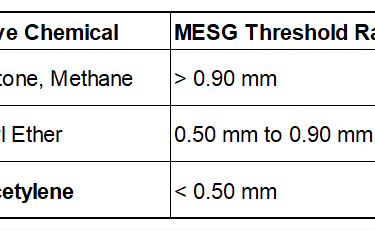
Flame arresters cannot be purchased as generic off-the-shelf items; they must be precisely engineered to match the chemical composition of the volatile gas, dictated by the Maximum Experimental Safe Gap (MESG):